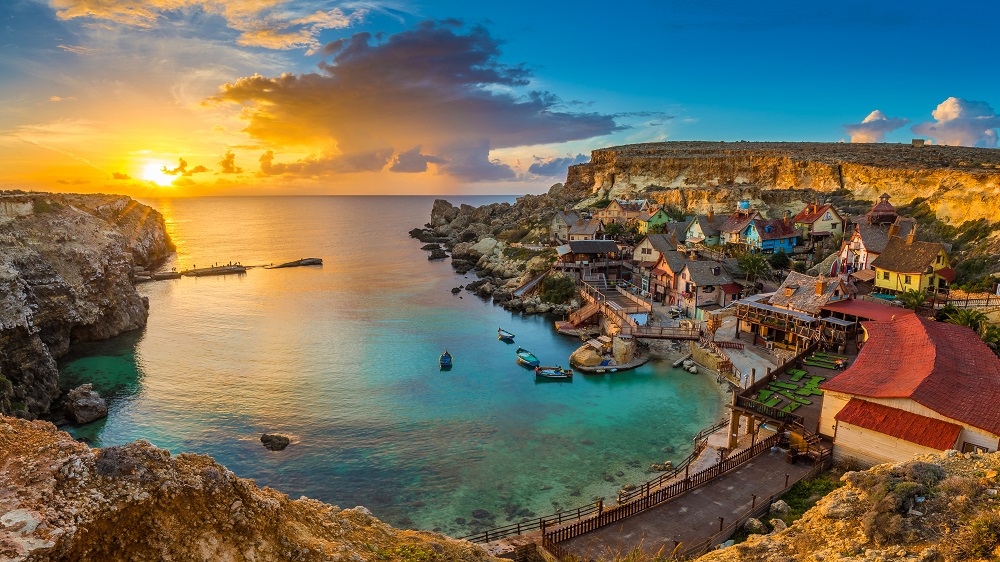
St Peter's Pool, the postcard
Near Marsaxlokk in the south-east, a natural pool carved into a flat limestone slab, with water of rare transparency and improvised jumping spots in the rock. It is the island's most photographed spot after the Blue Lagoon, and it fills accordingly between eleven and four in summer. Early in the morning you nearly have it to yourself. There is no shade, no kiosk and no lifeguard: you bring everything.
Getting there, the sticking point
No bus serves St Peter's Pool directly. From Marsaxlokk, allow thirty to forty minutes walking on an unshaded track, or a taxi that drops you at the end of the road. Plenty of groups go by quad or scooter hired for the day. The last stretch is on foot over uneven rock: flip-flops will not do.
Ghar Lapsi, the Maltese cove
On the south coast, below the Dingli cliffs. More discreet, more sheltered, with a small stepped structure cut into the rock for getting into the water and a restaurant right above. It is a place where you meet Maltese families rather than tourists, which tells you plenty. The water stays calm even when the sea is moving elsewhere.
Wied il-Ghasri, the Gozo cleft
On Gozo's north coast, a narrow fissure between two cliffs with a pebble beach a few metres wide at the bottom. You get down by a stairway cut into the stone. It is the most striking place in the archipelago and the least suited to a big group: with ten people it is full. Avoid it in rough seas, the swell funnels straight into the cleft.
What to bring
Water shoes, non-negotiable: the rock is sharp and sometimes covered in sea urchins. Water, because there is nothing on site. Sun cream and something for shade, because there is none naturally. And cash if you are counting on a food truck, which does not always take cards.
The safety rules that matter
None of these places has a lifeguard. The jumping spots at St Peter's Pool are natural, so depth varies with tide and position: nobody jumps without swimming out to check first. Getting in and out happens on wet rock, and that is where ankles go. And in a running sea, exposed coves turn dangerous very quickly.